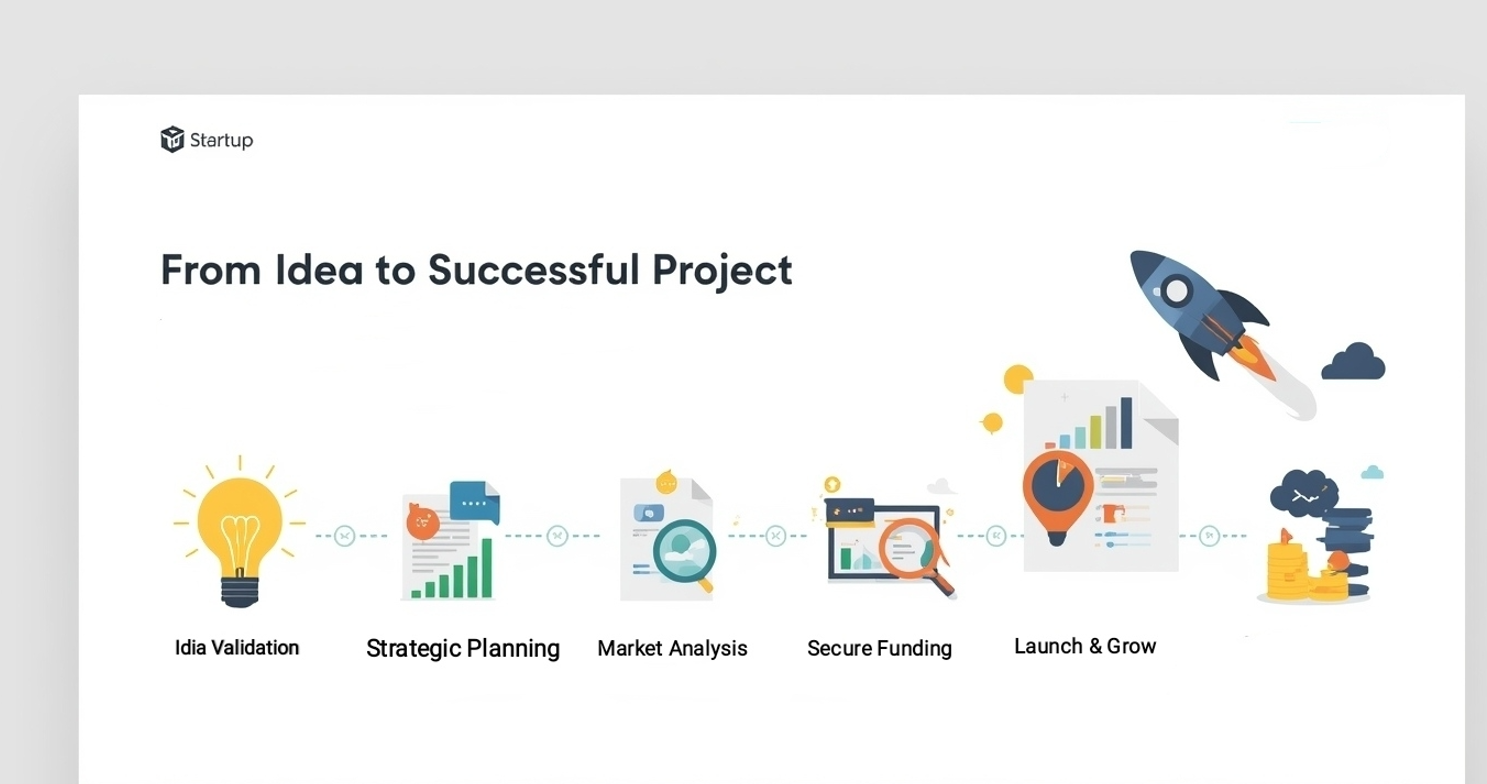

In the world of entrepreneurship and innovation, a new idea is the spark that sparks any successful venture. But what separates an idea that will change the market from one that will fizzle out after investing time and money? The answer lies in idea validation. One of the most powerful tools that enables you to take this crucial step is questionnaires.
Don't leave the fate of your idea to guesswork or conjecture; data is the fuel that fuels sound strategic decisions. Whether you're a startup looking for an investor or technical partner to implement it, or an established startup looking to evaluate a new expansion opportunity, this guide will help you use questionnaires to your advantage.
What are questionnaires? More than just questions
A questionnaire is a systematic research tool designed to collect large amounts of quantitative and qualitative data from your target audience. It consists of a set of robust questions that can be:
* Closed (quantitative): such as "yes/no" questions, multiple choice questions, or "Likert scale" (from 1 to 5). Ideal for measuring general trends and analyzing them statistically.
* Open (qualitative): Allows respondents to freely express their opinions. It is invaluable for understanding the "why" behind decisions and discovering unexpected insights.
Places to publish surveys in the digital age:
* Specialized Forms platforms (Google Forms, Typeform, JotForm).
* Social media (especially specialized groups on Facebook or LinkedIn).
* Email lists of current or potential customers.
* Embedded within a company's website or app.
Why are surveys vital to your success?
To build a successful MVP or scale your current project, you need tangible evidence. Surveys offer this through:
1. Speed and efficiency: Within hours, you can reach hundreds of participants from your target audience, significantly accelerating the product development cycle.
2. Reduced costs and risks: Compared to in-depth interviews or focus groups, surveys are significantly less expensive, protecting startups' investment capital and reducing the risk of failure.
3. Objectivity and analyzability: They reduce researcher bias and provide clear numerical data that can be analyzed to prove or disprove a business hypothesis.
4. Flexibility and adaptability: They can be used at various project stages, from initial idea feasibility study to measuring the satisfaction of your startup's existing customers.
Using surveys for idea validation: A practical guide
This is the crucial moment when the tool becomes a strategic action.
Follow these steps to get the most out of your survey.
Step 1: Strategically Define Your Target and Audience
* For the startup owner: Define exactly what you want to test: "Is there a real need for product X?" or "What is the most attractive feature of my idea?" Your audience is the demographic segment you believe will struggle with the problem you solve.
* For the startup owner: Focus on testing a specific expansion opportunity: "Would our existing customers be interested in a new product Y?" or "What is the optimal price for our premium service?" Your audience here could be your existing customers (for a complementary product) or a completely new segment.
Step 2: Design smart questions to collect actionable data
* Screening questions: To ensure you're addressing the right audience (e.g., "Have you encountered problem X in the last 6 months?").
* Quantitative assessment questions: "On a scale of 1 to 5, how likely are you to purchase a product that solves problem X?" These questions give you clear numbers.
* Qualitative open-ended questions: "What is the biggest obstacle you face when tackling problem X?" These questions give you a deeper understanding and uncover gaps you hadn't considered.
Step 3: Smart Distribution on the Right Channels
* Target the communities and platforms where your audience resides precisely. Don't send a survey about an advanced technical application to a public Facebook group.
* Leverage networks like LinkedIn to reach professionals in a specific field.
* Use email lists if you have them.
Step 4: Comprehensive Analysis of Results and Decision Making
* Quantitative Analysis: Calculate percentages, averages, and correlations. What percentage of respondents said they were "very likely" to purchase the product? If it exceeds 40%, that's a strong positive sign.
* Qualitative Analysis: Look for recurring patterns in open-ended responses. What words were repeated? What are the common criticisms?
* Data-backed decision making:
* Positive results: This is the data you can present to developers or investors to prove the viability of the market. You can move forward with greater confidence.
* Negative or neutral results: This isn't a failure, but rather an early rescue. Use potential customer feedback to pivot or modify your idea before you exhaust your resources.
Conclusion: Don't build in a vacuum, build based on data.
Surveys are more than just a data collection tool; they're a bridge between your entrepreneurial intuition and the reality of the market.
They give you the legitimacy and confidence to move forward with ideas or make the difficult decision to abandon a non-viable idea.
Investing in validating an idea through surveys isn't a cost; it's one of the most powerful forms of insurance for entrepreneurial ventures.
Start today, design your first survey, and read what the market is telling you clearly. This step could be the difference between a successful venture and one that's just a story to tell.
You might also like